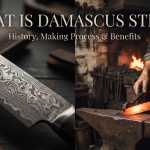
What Is Damascus Steel? History, Making Process & Benefits
Few materials in knife making carry a reputation like Damascus steel does. People recognize that flowing, layered pattern even if they've never held a knife in their life. And it's not just about looks — there's real craftsmanship behind it, the kind that takes years to get good at.
Damascus steel sits right at the overlap of tradition and actual performance. Different steel types get forged together, using a process refined over generations, and what comes out is a blade that looks distinctive and still holds up in daily use. That's really the whole appeal. Enthusiasts want it. Collectors want it. Regular users who just want a good knife end up wanting it too, once they understand what they're looking at.
This guide breaks down what Damascus steel is, how it gets made, where the name came from, and what's worth knowing before you decide it's the right choice for your next knife.
What Is Damascus Steel?
Damascus steel is known for one thing: that distinctive, flowing pattern — light and dark bands that swirl or ripple across the blade. It's not painted on. It's not etched in afterward as decoration. The pattern is built into the steel itself, layer by layer, during forging.
Most modern Damascus falls under what's called pattern-welded steel. Multiple layers of different steel types get forged together, then the whole billet gets folded and shaped repeatedly until those layers form the pattern the blade is known for. What that pattern ends up looking like depends a lot on which steels were chosen and how the maker managed the process.
Damascus steel and premium knives have become synonymous at this point, and there's a reason for that. Producing it consistently takes real skill. Not every knife maker bothers to learn it, which naturally narrows the field to people who are serious about the craft rather than churning out blades on a schedule.
History of Damascus Steel
The name goes back further than most people realize, though the connection between that original material and what gets called Damascus steel today is a little more complicated than it usually gets credit for.
Historically, the name is tied to wootz steel, a crucible steel that came out of South Asia and was traded and worked into weapons across the Middle East for centuries, Damascus itself being one of the cities where that trade and craftsmanship really took hold — hence the name sticking. Wootz steel had its own distinctive surface pattern, caused by a particular crystalline structure that formed during production, and blades made from it earned a real reputation, both for how they looked and for how well they held up in use.
At some point, the specific methods and material sources behind that original wootz production got lost. Nobody knows exactly why. Historians point to a few possibilities — shifting ore sources, changing trade routes — but there's no single confirmed answer, and it's worth staying skeptical of anyone who presents one theory as settled fact.
What people call Damascus steel today is a related but genuinely different craft. Pattern welding developed over time as smiths tried to recreate the look of those historical blades using the methods they had available. It isn't the same process as ancient wootz production, and any source being careful about history will say so directly rather than blur the two together. That doesn't make modern Damascus any less demanding, though. It's a real craft, and that's exactly why the name still carries weight in knife making today.
Over time, this modern take on Damascus steel became tightly linked with premium, handcrafted blades, mostly because of how much skill it demands. Getting a clean, well-defined pattern takes real forging experience, and that link to genuine craftsmanship is a big part of why Damascus knives still hold the reputation they do.
What Is Damascus Steel Made Of?
It isn't one material. That's the first thing to understand. Damascus steel is a combination — multiple steel types, layered and forged together into a single blade.
Most modern Damascus starts as a stack of different steels, usually two or more varieties chosen because they behave differently under heat and under acid etching later. Carbon steel combinations show up often since different carbon steels create strong visual contrast once the blade gets etched. Some makers work stainless steel into the mix too, usually trying to balance corrosion resistance against how much visual contrast they're after.
The pattern itself comes entirely from the layering. Fold and forge the steel enough times and the layer count climbs fast, sometimes into the hundreds. Every layer plays a part in the final look, and how those layers get manipulated — twisted, ground down, folded a certain direction — decides whether you end up with flowing waves, a ladder pattern, or something looser and more random.
Two things really determine the outcome: which steel went in, and how the forging was managed. Change either one and the blade comes out different, both in how it looks and how it performs.
How Damascus Steel Is Made
There's a real sequence to this. Skip a step or rush one and it shows in the finished blade.
Step 1: Steel Selection
It starts with picking steels that are compatible with each other. They need to respond to heat in similar ways during forging, because mismatched steels cause problems down the line — weak bonds between layers, uneven hardness, a pattern that just doesn't come out right.
Step 2: Layer Preparation
Once the steels are chosen, they get stacked into a billet. How thick each layer is and what order they're stacked in has a direct effect on the eventual pattern.
Step 3: Forge Welding
The billet gets heated hard and then hammered or pressed until the layers fuse into one solid piece. This step is genuinely demanding. Getting a clean weld between layers takes real control over both heat and technique, and it's easy to mess up.
Step 4: Folding & Layer Formation
The welded billet usually gets folded and forged again, several times over, which multiplies the layer count and starts building real complexity into the pattern. Some smiths fold a billet a dozen times or more, depending on how intricate they want the final design.
Step 5: Shaping the Blade
Once there are enough layers, the billet gets drawn out and shaped into an actual blade profile. This is where the overall geometry gets set, before grinding and finishing refine it further.
Step 6: Acid Etching
This is the step where the pattern finally shows up. A mild acid gets applied to the blade, and it reacts differently with each steel layer, darkening some and leaving others lighter. That contrast is what reveals the pattern that was hiding inside the metal the whole time.
Step 7: Final Finishing
Polishing, sharpening, any last surface work — this is what turns a shaped blade into a finished knife.
Every single one of these steps changes the outcome somehow. Small variations at any point can shift the result more than people expect. If you want a deeper dive into how this fits into building an actual finished knife, our knife making process page covers that from raw material all the way to completion.
Benefits of Damascus Steel Knives
A few reasons explain why this reputation has stuck around so long.
Unique Appearance
No two Damascus blades ever pattern the same, even under near-identical conditions. That, combined with the obviously handmade character of a process this hands-on, is a big part of the draw. Nobody manufactured that look on purpose in a factory somewhere — it's a genuine byproduct of how the blade came together. That same unpredictability is what gives each piece its individuality; the pattern isn't applied afterward, it's baked into the steel itself, so owning one really does mean owning something nobody else has.
Durability
A properly forged Damascus blade holds up well, assuming the steel selection and the forging itself were both managed with care. Heat treatment matters enormously here — it's what gives the blade its actual strength, not just the layering itself. Even a stunning pattern won't save a blade that wasn't heat treated correctly, so durability really comes down to the skill behind the whole process, not just which steel got picked. Done right, that same heat treatment is also what gives the blade its toughness, meaning it can absorb impact and stress without chipping or snapping, which matters more than people expect once a knife is being used rather than just admired.
Edge Performance
Good Damascus steel takes a genuinely sharp edge and cuts well, provided the steels involved were chosen with performance in mind rather than purely for contrast. This is where the practical value shows up day to day, not just when the knife's sitting in a display case looking impressive. Edge retention tends to be a strong point too, since combining harder and softer steels in the forging process can let the blade hold a working edge longer than a lot of single-steel options. A well-forged blade also tends to carry good balance, with the weight distributed in a way that makes the knife feel controlled in hand rather than front-heavy or awkward, which matters just as much as sharpness when it comes to using the thing.
Collector Value
Since every blade carries its own individual pattern, these knives tend to hold serious appeal for collectors. Craftsmanship plus genuine uniqueness is a combination that's hard to find elsewhere, which is a big reason Damascus knives get sought after both as tools and as collectible pieces. That same combination tends to help with resale value over time, since a well-made, well-documented piece from a skilled maker isn't easy to replace or reproduce, and buyers in that market know it.
Here are the three new sections, written to match the existing voice and placed where they'd fit in the document flow.
Common Damascus Steel Patterns
The pattern is where a lot of a Damascus blade's character comes from, and different forging techniques produce genuinely different looks.
Twist
Created by twisting the billet before it's shaped, which produces a spiraling, rope-like pattern running down the blade. It's one of the more recognizable styles, largely because the motion is so visible in the finished steel.
Raindrop
Made by drilling or punching holes into the layered billet before it's forged flat again, leaving behind a pattern of rounded, teardrop-shaped marks scattered across the surface.
Ladder
Produced by grinding notches into the billet at intervals before forging, which creates a repeating, rung-like pattern that runs across the blade rather than along its length.
Feather
Achieved by splitting and folding the billet in a way that mirrors the structure of a feather, with fine lines branching outward from a central spine. It's a more delicate, detailed pattern and tends to reflect a higher level of forging skill.
Random
The result of standard folding and forging without any deliberate manipulation of the layers, which produces a flowing, organic pattern that varies naturally from blade to blade.
Firestorm
A denser, more chaotic variation on random patterning, usually built from a higher layer count, giving the blade a busier, more textured look.
None of these patterns is inherently "better" than another — which one suits a given knife that comes down to personal taste and the maker's intent, not a hierarchy of quality.
Common Myths About Damascus Steel
A material with this much history attracts its share of misconceptions. Worth clearing a few up.
Myth: Damascus steel never gets dull.
Like any steel, a Damascus blade dulls with use. Edge retention can be strong if the steel and heat treatment were managed well, but "sharp forever" isn't realistic for any knife.
Myth: Every Damascus knife is ancient or historically authentic.
Most Damascus knives sold today are pattern-welded steel, a modern craft that developed after the original wootz process was lost. That doesn't make them less legitimate — it just means the "ancient blade" framing is more marketing than fact.
Myth: Pattern equals quality.
A visually striking pattern says something about the maker's skill with the forging and etching process, but it doesn't guarantee the blade underneath performs well. Heat treatment and steel selection matter just as much, if not more.
Myth: More layers always mean better steel.
A higher layer count can produce a more intricate pattern, but it doesn't automatically translate to better edge performance or durability. Past a certain point, added layers are mostly a visual choice.
Myth: Damascus steel never rusts.
Whether a blade rusts depends on which steel goes into it. Damascus, made with carbon steel layers, reacts to moisture the same way any carbon steel would, which is exactly why maintenance matters.
Heat treatment often matters as much as steel selection, and pattern alone does not determine knife quality — both are worth keeping in mind before assuming a good-looking blade is automatically a good-performing one.
Why Knife Enthusiasts Trust Centuries Crafts
Buying a Damascus knife means trusting that the craftsmanship behind the pattern is as solid as the pattern itself. A few things set that trust apart.
Handmade production
Every blade is forged by hand, not mass-produced on an assembly line. That hands-on process is exactly what gives each piece its individual character, rather than a look copied across hundreds of identical knives.
Experienced craftsmen
The people doing the forging have spent years developing the skill this process demands. A well-defined pattern and a properly heat-treated blade aren't accidents — they come from craftsmen who understand how different steels behave under heat and know how to work with that rather than against it.
Premium steel selection
Reputable makers disclose the steels used in a blade, and that transparency matters. Steel choice affects both how the blade performs and how the finished pattern turns out, so it's chosen deliberately rather than picked at random.
Inspected before shipping.
Every blade goes through inspection before it leaves — checked for consistent pattern lines, sound construction, and a superbly finished edge — so what arrives matches what was promised, not just what looked good in a listing photo.
Handmade leather sheath.
Each knife is paired with a handmade leather sheath, built with the same attention as the blade itself rather than treated as an afterthought.
Customer satisfaction.
A well-forged Damascus blade is judged by performance as well as appearance, and that's reflected in the feedback from the people using these knives day to day — not just admiring them on a shelf.
Damascus Steel vs Other Knife Steels
Damascus isn't automatically the "best" option compared to other knife steels. It's different, with trade-offs like anything else, and knowing those trade-offs helps figure out if it's the right fit for what you need.
| Steel Type | Main Strength | Trade-Off |
| Damascus Steel | Appearance and craftsmanship — a well-made blade looks like nothing else, reflecting the skill of whoever made it | Appearance and craftsmanship — a well-made blade looks like nothing else, reflecting the skill of whoever made it |
| Stainless Steel | Corrosion resistance — manages moisture and general wear with far less babysitting | Some trade-offs in raw edge performance compared to other steels |
| Carbon Steel | Edge performance — takes an extremely sharp edge and holds it well | Develops a patina over time from use and exposure; many owners like the character this gives the blade, but it's worth knowing going in |
None of these three wins outright. It comes down to what matters for the knife in question: appearance and craftsmanship, low-maintenance reliability, or squeezing out maximum edge performance.
Damascus Steel Maintenance
Damascus blades need more attention than a standard stainless knife, mostly because the layered steel involved reacts to moisture more readily.
Keeping the blade dry matters more here than with most knife types — standing moisture can start affecting the steel quickly if it's left. Hand wash only, and never the dishwasher — the heat, harsh detergent, and prolonged moisture exposure in a dishwasher cycle are rough on Damascus steel and can dull the pattern's contrast over time. After washing, dry the blade immediately rather than letting it air dry, since even a few minutes of standing water can be enough to start oxidation on this kind of steel.
Acidic foods deserve extra attention. Ingredients like citrus, tomatoes, or vinegar can react with the steel faster than neutral foods, so it's worth wiping the blade down and applying a light coat of oil after cutting anything acidic, even if it's just going to sit for a short while before the next use. A light coat of protective oil, applied regularly, helps head off oxidation and keeps the pattern looking sharp instead of dull and washed out. Harsh chemicals are worth skipping entirely since they can mess with both the steel and the contrast that makes the pattern visible in the first place.
Sharing also deserves some care. Keeping a consistent angle — typically in a similar range to other high-performance kitchen or working knives — helps preserve the edge geometry and avoids uneven wear across the pattern. Freehand sharpening without attention to angle can wear the blade unevenly over time, so a guide or steady hand matters more here than on a basic stainless blade.
Storage rounds it out. Dry, protected, and kept away from other hardware that could scratch the surface over time. If the knife is kept in a leather sheath, don't store it there long-term — leather can hold in residual moisture and humidity against the blade, which is exactly the kind of slow, unnoticed exposure that leads to spotting or corrosion. It's better to store the blade separately in a dry environment and only use the sheath for carry or short-term storage. More generally, humidity is worth paying attention to wherever the knife lives. A damp drawer, a humid kitchen, or a coastal climate can all accelerate the need for maintenance, so more frequent oiling and checking makes sense in those conditions.
How to Choose a Damascus Knife
A handful of practical things are worth thinking through before buying.
Steel quality and craftsmanship. A striking pattern on a poorly forged blade doesn't make up for weak performance underneath it, so it's worth looking past the visual appeal and asking what steel went into it. Heat treatment matters just as much, since it's what determines how well the blade holds an edge and resists damage, regardless of how good it looks. Craftsmanship is worth checking directly — clean, well-defined pattern lines and consistent finishing are usually a decent sign that whoever made it took the process seriously rather than rushing it.
Blade purpose. What the blade's for should guide the decision, since a well-made knife's steel, geometry, and size usually reflect its intended job:
- Kitchen — favors thinner, precise blades suited to slicing and control.
- Chef — a specific kitchen role, typically a broader blade for chopping, dicing, and general prep.
- Utility — built for everyday light-duty tasks like cutting cord, opening boxes, or general odd jobs.
- EDC (everyday carry) smaller and easy to carry, balancing portability with enough capability for daily tasks.
- Hunting — shaped for skinning and field dressing, usually with a curved edge suited to that work.
- Bushcraft — geared toward outdoor tasks like carving, buttoning, and general survival use, so it needs to hold up to harder use.
Blade length
Length should match the intended task — shorter blades suit precision and portability (EDC, detail kitchen work), while longer blades suit tasks needing reach or power (hunting, bushcraft, chopping). Going too long or too short for the intended use undercuts the knife's practicality.
Tang.
The tang — how far the blade's steel extends into the handle — affects strength and balance. A full tang, where the steel runs the entire length of the handle, holds up better under heavy use and is worth prioritizing for hunting, bushcraft, or any knife expected to take real stress.
Handle material
Daily carry calls for a different handle than something meant for display or collecting, so it's worth thinking about how the knife will get used before locking in a specific design:
- Olive wood — warm, distinctive grain, valued for its natural look.
- Walnut — a classic wood choice with a rich, dark tone.
- Micarta — a durable, resin-layered material that holds up well to moisture and hard use.
- G10 — a rugged fiberglass composite known for its grip and toughness, common on working knives.
- Resin — often used for colorful, custom designs where appearance is part of the appeal.
Sheath
The sheath matters as much as the knife itself for everyday practicality:
- Leather — a traditional option with a classic look, though it needs some care to avoid moisture damage.
- Kyden — a rigid, low-maintenance material that offers a secure, consistent fit and holds up well to wear.
Frequently Asked Questions - What Is Damascus Steel
What is Damascus steel?
A type of steel known for its distinctive layered pattern, usually made today through pattern welding — forging multiple steel types together until they form the wavy, rippled look the name is known for.
What is Damascus steel made of?
Multiple steel types combined, often different carbon steels and sometimes stainless steel, layered and forged into one billet. Whatever steels get used to affect both the final pattern and how the blade performs.
How is Damascus steel made?
Compatible steels get selected, layered, and forge welded together, then folded repeatedly to build layers. The billet gets shaped into a blade, acid etched to reveal the pattern and finally polished and sharpened.
Are Damascus knives better than regular knives?
Not really "better," simply different. Damascus offers distinctive looks and real craftsmanship. Other steels might offer easier upkeep or different edge characteristics depending on the type.
Is Damascus steel real?
Yes, genuinely. Modern Damascus is a real, demanding forging process that produces actual pattern-welded steel — though it's a distinct craft from the historical wootz steel the name originally came from, not the exact same thing.
Are Damascus steel knives worth it?
For a lot of buyers, yes, especially anyone who cares about craftsmanship, distinctive looks, or owning something that's genuinely one-of-a-kind. Whether it's "worth it" really depends on what someone wants out of a knife in the first place.
Does Damascus steel rust?
It can depend on which steel went into the layering. Blades that include carbon steel layers react to moisture more easily than fully stainless options, which is exactly why regular maintenance matters here.
How do I care for Damascus steel?
Keep it dry after use, apply protective oil regularly, skip harsh chemicals, and store it properly so it isn't exposed to moisture or getting scratched up over time.
Explore Our Damascus Knife Collection
Damascus steel earns its reputation through real skill, careful material choices, and a demanding process. Not just because the pattern happens to look interesting. Understanding what goes into a blade like this makes it a lot easier to appreciate what you're holding once you pick one up.
If you're ready to see all of that in a finished piece, our Damascus knife collection was built entirely around it.
Latest Posts