How Knives Are Made: The Complete Knife Making Process
A good knife doesn't happen by accident. Skill, the right materials, and a lot of precision go into every single one, and that's true whether you're talking about a simple kitchen knife or a fully custom Damascus build.
Every handcrafted knife follows a real process. Not a loose set of steps someone eyeballs, but a sequence that's been refined through actual experience — design first, then material.
How Knives Are Made
At a high level, most handmade knives go through the same core stages, even though the specifics shift depending on the knife type and the maker.
It starts with design and planning — figuring out what the knife needs to do before anyone touches steel. From there comes material selection, choosing the actual blade steel and handle material based on that intended use. Blade shaping and forging or cutting follow, where the raw material actually starts becoming a knife. Heat treatment comes next, which is arguably the single most important step for how the finished blade performs. After that, grinding and sharpening establish the actual edge geometry. Handle installation follows, fitting and securing the handle to the finished blade. Finishing covers polishing and any final surface work. And quality inspection closes out the process - checking everything before the knife's considered done.
Each of these stages depends on the one before it. Skip ahead or cut corners early and it's nearly impossible to fix later without starting over.
Knife Design & Material Selection
Every knife starts as a decision, not a piece of steel.
Design Process
Blade purpose comes first. Is this knife for hunting, kitchen work, everyday carry, or display? That answer shapes almost everything downstream. Shape selection follows from purpose — a drop point suits general use, while something like a clip point or tanto fits more specialized tasks. Size and dimensions matter too, since a blade that's too long or too heavy for its job ends up disappointing no matter how well it's made. And intended use ties all of this together, since a knife meant for daily carry gets designed differently than one meant purely for a collection.
Material Selection
Once the design is locked in, blade steel gets chosen based on what the knife actually needs to do. Some steels prioritize edge retention, others corrosion resistance, others visual character — Damascus being the obvious example there. Handle materials get picked with similar logic, weighing grip, durability, and appearance against the knife's intended use. Performance requirements really tie the whole selection process together. A hunting knife and a kitchen knife might use completely different steels, not because one's better, but because they're solving different problems.
Forging a Knife
Forging is where a knife genuinely starts to take shape, and it's a process that rewards experience more than almost any other stage.
Heating the Steel
Everything begins with heat. The steel gets brought up to forging temperature, which varies depending on the specific alloy, but generally needs to reach a point where the metal becomes workable without being molten. Getting this right matters enormously — steel that's underheated resists shaping and risks cracking, while overheated steel can lose some of its structural integrity before it's even been forged into anything.
Hammering & Shaping
Once the steel's at temperature, the actual forming begins. Repeated hammering, whether by hand or with power hammers, forms the blade's basic profile. This is where the knife's overall geometry starts to emerge — length, width, and that early sense of where the edge and spine will eventually sit. Thickness and balance get controlled carefully at this stage too, since a blade that's forged unevenly is hard to correct later without removing a lot of extra material during grinding.
Cooling & Refinement
After the initial shaping, the blade gets allowed to cool, usually gradually rather than rapidly, before any further work happens. This stage sets up the blade for what comes next: heat treatment. A blade that's been shaped well but rushed through cooling can develop internal stress that causes problems down the line, so this step matters more than its simplicity suggests.
How to Forge a Knife
Breaking the forging process into concrete steps helps make sense of what's actually happening at each stage.
Select suitable steel first, based on the knife's intended purpose and how that steel responds to forging heat. Heat the steel in a forge until it reaches a workable temperature, one that allows shaping without damaging the metal's structure. Shape the blade through hammering, gradually forming the basic profile and establishing thickness. Normalize the steel — a controlled heating and cooling cycle that relieves internal stress built up during shaping, which helps the blade take heat treatment more evenly later. Heat treat the blade through hardening and tempering, the step that actually determines how well the finished knife will perform. Grind the edge to establish the actual cutting geometry. And finally, polish and finish the blade to reach its final appearance.
None of this happens quickly, and none of it forgives guesswork. Real forging takes genuine experience, a working knowledge of how different steels behave under heat, and a level of precision that only comes from doing it repeatedly. It's a craft that punishes shortcuts, which is exactly why handmade blades from an experienced maker perform so differently from something stamped out on an assembly line
Heat Treatment: Creating Blade Strength
If forging shapes a knife, heat treatment is what actually makes it perform. This single step has more influence over how a finished blade behaves than almost anything else in the process.
Hardening comes first — heating the blade to a specific temperature, then cooling it rapidly, usually through quenching in oil or water depending on the steel. This hardens the steel's structure at a molecular level, giving the blade the ability to hold a sharp edge. Done without enough control, hardening alone leaves a blade brittle, which is exactly why it never stands alone.
Tempering follows right after, and it's what corrects that brittleness. The hardened blade gets reheated to a lower temperature and held there, which relieves internal stress and adds back some flexibility without sacrificing much of the hardness gained during quenching. Skip tempering and a hard blade can crack or chip under stress that a properly tempered one would shrug off entirely.
Together, these two steps determine edge retention — how long a blade holds its sharpness under real use. They determine durability too, since a blade that's too hard becomes brittle, while one that's too soft dulls almost immediately. And they set the balance between hardness and flexibility that every good knife actually needs, since a blade with zero flex snaps under the wrong kind of pressure, while one that's too soft just bends.
Get heat treatment wrong, and no amount of good forging or grinding afterward can fully make up for it. It's genuinely the step where a knife's real performance gets decided.
Grinding, Sharpening & Finishing
Once heat treatment is done, the blade moves into the stage that shapes how it actually cuts.
Grinding establishes the blade's geometry — the specific shape of the bevel that runs along the edge. This step also sets the edge profile, deciding whether the blade ends up with a flat grind, a hollow grind, or something more specialized depending on the knife's intended purpose. Grinding takes real precision, since uneven grinding leads to a blade that cuts inconsistently no matter how good the steel underneath happens to be.
Sharpening comes next, refining that ground edge into something genuinely capable of cutting cleanly. This is where the actual cutting performance gets dialed in, taking the rough edge left by grinding and bringing it to a real working sharpness.
Finishing covers whatever comes after the edge is set. Polishing brings out the blade's final look, whether that's a mirror shine, a satin finish, or something more textured like a stonewashed surface. Surface treatments beyond polishing, when used, add both protection and visual character. And this stage is really what determines the knife's final appearance — the difference between a blade that looks finished and one that looks like it's still a work in progress.
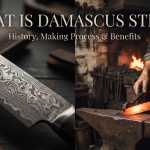
Damascus Knife Making Process
Damascus knives follow the same broad structure as any other handmade blade, but with several additional steps layered in specifically to create that distinctive pattern.
It starts with selecting steel combinations — choosing two or more compatible steel types that behave predictably together under heat and etch differently once the blade is finished. Layer preparation follows, stacking those steels into a billet in a specific arrangement that will influence the eventual pattern. Forge welding then fuses those layers into a single solid piece through heat and hammering, a step that demands real control since a poor weld creates weak points in the finished blade.
From there, folding and pattern development multiplies the layer count, sometimes into the hundreds, building the visual complexity the blade will eventually show. Blade shaping forms the layered billet into an actual knife profile, similar to standard forging but working with a more complex piece of steel. Heat treatment follows the same principles covered earlier — hardening and tempering — applied to the now-layered blade.
Acid etching is where the pattern finally becomes visible, since the different steel layers react differently to the acid, creating the contrast that reveals the design hidden inside the metal. Final finishing closes out the process with polishing and any last surface work.
For more detail on Damascus steel specifically — what it's made of, its history, and how it compares to other steels — our Damascus Steel Guide covers that in depth. And if you want to see this craftsmanship in a finished piece, our Damascus Knives collection is built entirely around it.
Handle Making & Assembly
While the blade gets most of the attention, the handle plays just as real a role in how a knife feels and performs.
Handle material selection happens early, chosen based on grip, durability, and how the finished knife is meant to look. Scale preparation follows, shaping the chosen material — wood, Micarta, G10, or something else — into the actual pieces that will form the handle. Attachment methods vary by knife design, but the goal is always the same: a genuinely secure handle, not just cosmetically fitted. Ergonomic shaping refines that handle further, adjusting its contours so it actually sits comfortably in the hand rather than just looking good in photos. And final polishing brings the handle to the same finished standard as the blade itself, so the whole knife feels cohesive rather than like two separate parts bolted together.
Quality Inspection
Before any handmade knife is considered finished, it goes through a real inspection, not just a quick glance before packaging.
Blade alignment gets checked to confirm the edge sits true along the spine. Sharpness testing verifies the edge actually performs the way it's supposed to, not just that it looks sharp. Handle security gets checked too, making sure nothing shifts or feels loose under normal grip pressure. Finish quality gets a close look, checking for consistency across the blade and handle. And overall balance gets assessed as a whole, since a knife can pass every individual check and still feel wrong in the hand if the weight distribution is off.
This stage is really what separates handmade knives from mass-produced alternatives. A factory line checks for defects at scale. A handmade knife gets evaluated individually, by someone who actually understands what a well-made knife is supposed to feel like.
Handmade Knives vs Factory Knives
Both approaches have a place, but they're solving for different things entirely.
Handmade Knives. The value here is artisan craftsmanship — genuine skill applied at every stage, not just at the end. Designs can be fully unique rather than repeated across thousands of identical units. Attention to detail runs through the whole process, and materials get chosen deliberately based on performance rather than cost efficiency.
Factory Knives. The advantage is scale — large-scale production that keeps costs low and turnaround fast. For knives where consistency and affordability matter more than individuality, factory production makes complete sense.
Collectors and serious enthusiasts tend to gravitate toward handmade craftsmanship specifically because of what factory production can't replicate: genuine individuality, visible skill in every stage of the build, and the kind of attention that only comes from a person, not a machine, evaluating each knife on its own.
Frequently Asked Questions
How are knives made?
Handmade knives go through design, material selection, forging or shaping, heat treatment, grinding, handle assembly, finishing, and a final quality inspection, with each stage building directly on the one before it.
How long does it take to make a handmade knife?
It varies widely depending on complexity, but a well-made custom or Damascus knife often takes anywhere from several days to a few weeks of actual working time, factoring in forging, heat treatment, and finishing.
What is the knife forging process?
Forging involves heating steel to a workable temperature, hammering it into shape, then cooling and refining that shape before it moves on to heat treatment and further finishing.
How is Damascus steel made?
Multiple steel types get layered, forge welded, and folded repeatedly to build up complexity, then shaped into a blade and acid etched to reveal the pattern hidden within the layered steel.
What steel is best for knives?
It depends entirely on intended use — Damascus for craftsmanship and appearance, carbon steel for edge performance, stainless steel for low-maintenance reliability. There's no single best option across every use case.
Are forged knives stronger?
Generally, yes, when the forging and heat treatment are both done well. Forging can improve the internal grain structure of the steel, contributing to better overall strength and durability compared to some other manufacturing methods.
What makes handmade knives different?
Individual attention at every stage, materials chosen deliberately rather than for cost, and a level of craftsmanship that shows up in the details a factory process typically can't replicate at scale.
See the Craftsmanship for Yourself
Every step in this process exists for a reason, and skipping any of them shows up eventually in how a knife performs. That's really the whole case for handmade craftsmanship — not just tradition for its own sake, but a process that consistently produces better results when it's done right.
If you're ready to see that craftsmanship in a finished piece, our collections cover everything from fully custom builds to Damascus knives made using exactly this process.
Latest Posts